Paris Riots – PSG Victory Celebrations Turn to Chaos, Nearly 900 Arrests
The victory celebrations for Paris Saint-Germain’s (PSG) historic second consecutive Champions League title turned into a night of widespread chaos and destruction across France. What began as jubilation in Budapest after their penalty shootout win over Arsenal escalated into violent riots in Paris and other cities, resulting in nearly 900 arrests, hundreds of injuries, and at least one fatality.
French authorities have described the scenes as “absolutely unacceptable,” with Interior Minister Laurent Nuñez confirming that security forces will respond with a “firm” hand as the country reels from the events of Saturday night.
The Night of Chaos
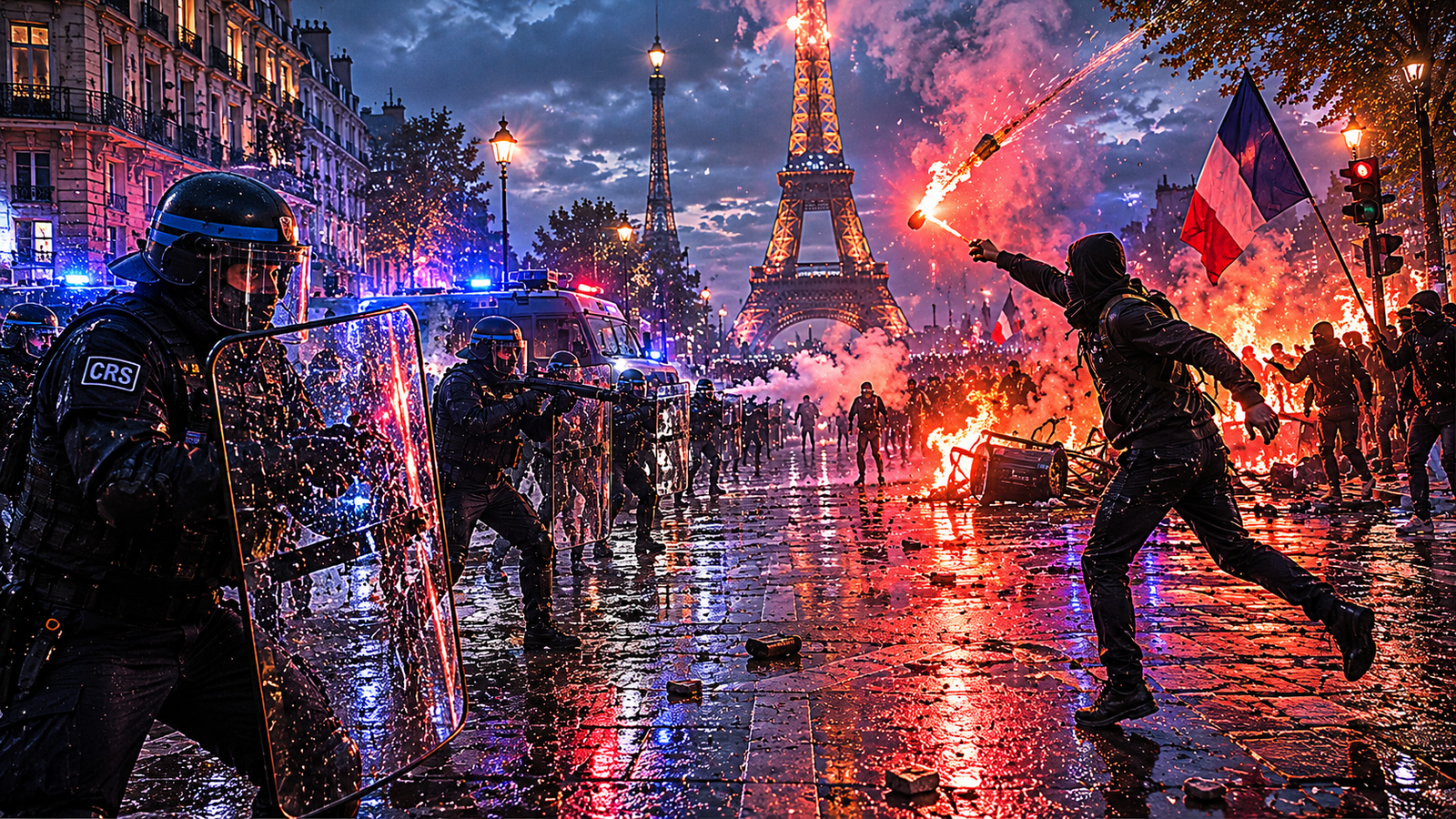
After PSG secured their 4‑3 penalty shootout victory in Budapest, tens of thousands of supporters poured onto the streets across France, with Paris’s iconic Champs‑Élysées acting as a major focal point. Approximately 20,000 fans gathered along the famous avenue shortly after the final whistle to celebrate the club’s triumph. However, the celebratory atmosphere quickly deteriorated as groups broke away, with reported “massive disturbances” that police struggled to contain.
Social media footage that has since gone viral shows flares being set off, electric bikes and other vehicles set ablaze on roads, and revellers smashing the glass of storefronts. In some of the most alarming footage, individuals were seen using fireworks, including powerful “加特林烟花” (Gatling‑style fireworks), which were fired directly at law enforcement. Crowds also clashed with police, with some groups attempting to storm a police station.
Human Cost and Arrests : Paris riots 2026
According to the French Interior Ministry, a staggering total of nearly 900 arrests were made in connection with the riots.
This marks a 45% increase in arrests compared to PSG’s previous victory, indicating a significant escalation in violence year on year.
The Paris police alone accounted for 480 of these detentions.
The Paris prosecutor’s office confirmed that 277 individuals were taken into formal custody, including 82 minors.
Charges range from attacking security personnel, theft, and property damage, to the illegal possession of weapons.
The toll of the violence was severe.
Officials confirmed that 219 people were injured across the country, with eight in serious condition.
Law enforcement was hit particularly hard, with 57 officers injured as they attempted to restore order.
Tragically, the riots were also linked to at least one death.
A 24‑year‑old man died in a motorcycle accident on the Paris ring road, which rioters had attempted to block overnight.
Interior Minister Laurent Nuñez revealed that the unrest was not confined to the capital.
About 15 cities saw incidents of theft and looting, while “71 municipalities” experienced various violent incidents.
Damage was widespread, with reports of smashed shop fronts, torched vehicles, and damaged public infrastructure.
That included a bus shelter and a bakery near PSG’s Parc des Princes stadium.
Government and Political Reactions
The violence drew swift and scathing condemnation from the highest levels of the French government. President Emmanuel Macron, who later hosted the victorious PSG squad at the Élysée Palace, praised the team as an “immense pride” for France but did not mince words when it came to the rioters. He denounced the events as “unspeakable” and called for an end to the destruction. “Enough. We are fed up. This is not football, this is not sport, this is not what we love,” an exasperated President Macron stated.
Interior Minister Nuñez, who had preemptively deployed 22,000 police and gendarmes across the country in anticipation of potential trouble, stated that the situation was “largely brought under control” by Sunday morning. He criticized individuals who, he claimed, “are not PSG supporters and don’t even watch the match, [who] come to cause trouble and disturbances”. Despite the previous night’s violence, a victory parade at the Champ‑de‑Mars near the Eiffel Tower proceeded as planned on Sunday afternoon, with 6,000 police officers mobilized to ensure security.
Political leaders were quick to react. Far‑right leader Marine Le Pen took to social media to express her outrage, writing: “Only in France does a football club’s victory spark riots. Only in France does everyone feel compelled to lock themselves in their homes on the evening of a victory to avoid being confronted with violence”. Valérie Pécresse, the president of the Île‑de‑France region encompassing Paris, also condemned the violence, demanding sanctions against those responsible and stating that the “brainless thugs” had “tarnished the image of Paris and France”.
Analysis: A Deep‑Seated Crisis of Unrest
While the immediate trigger for the chaos was a sporting victory, the riots have exposed deeper, structural issues that continue to plague French society. The night of destruction did not occur in a vacuum but is the latest eruption of violence in a country that has become increasingly volatile.
A Broader Context of Societal Tensions
France has experienced significant social unrest over the past year, creating a simmering pot of tensions that external events can easily boil over. The last year has been marked by significant nationwide protests against President Emmanuel Macron’s deeply unpopular pension reform, which raised the retirement age from 62 to 64. Opposition to the reform was fierce, with powerful trade unions staging multiple days of mass demonstrations that, at times, turned violent. Critics have argued the reform is unfair to those in physically demanding jobs and to women who have interrupted their careers, and it has contributed to a nationwide climate of anger and defiance.
This discontent has been further fueled by repeated political crises, including the recent collapse of the government, which has seen Macron appoint multiple prime ministers in a short span, deepening public frustration with the political class. The “Block Everything” movement, which has staged disruptive protests over budget cuts and political paralysis, has also helped cement a “culture of the street” where mass disruption is seen as a legitimate tool to challenge the state.
The Issue of Sports‑Related Violence : Paris riots 2026
The ease with which a celebratory event devolved into a nationwide security crisis points to a specific failure of sports culture management in France. Saturday night’s riots were not an isolated incident but a repeat of the previous year when PSG’s first Champions League victory was similarly marred by widespread disorder, including two deaths. The fact that authorities deployed 22,000 personnel in anticipation of trouble, yet the violence still occurred on a larger scale than the previous year, suggests that current crowd control strategies are failing.
The violence was further fueled by the behavior of known hooligans and elements within the French “ultra” fan culture, which has a long history of using pyrotechnics and engaging in confrontations with security forces. As one official noted, many individuals arrested were not even in Budapest for the match but had specifically come to the streets of Paris to cause trouble.
The Deepening Urban Divide
The geography of the riots was telling. While the initial celebrations were concentrated on the iconic Champs‑Élysées, the violence quickly spread to the bustling peripheries and working‑class banlieues surrounding Paris. These are areas that have long been marginalized, struggling with high unemployment, poverty, and a legacy of tense relations with law enforcement. The memory of the widespread riots in 2023 following the police shooting of teenager Nahel Merzouk remains fresh, a stark reminder of the powder‑keg conditions in some of these communities. The violence seen on Saturday night—the torching of cars, the looting of stores, the clashes with CRS riot police—are an all‑too‑familiar pattern from those banlieue uprisings, suggesting deep‑seated grievances that have little to do with football and everything to do with social and economic exclusion.
The response from some local politicians also reveals the complex and often divisive nature of these tensions. Following last year’s similar PSG riots, the mayor of Chalon‑sur‑Saône controversially banned the Palestinian flag in his city, calling it a “rallying sign” for “Islamist gangs.” While the context of that ban was different, it highlights the political fragmentation and the way diverse social and political grievances can coalesce around high‑profile events.
Global Reactions: A “Dystopian” Reality
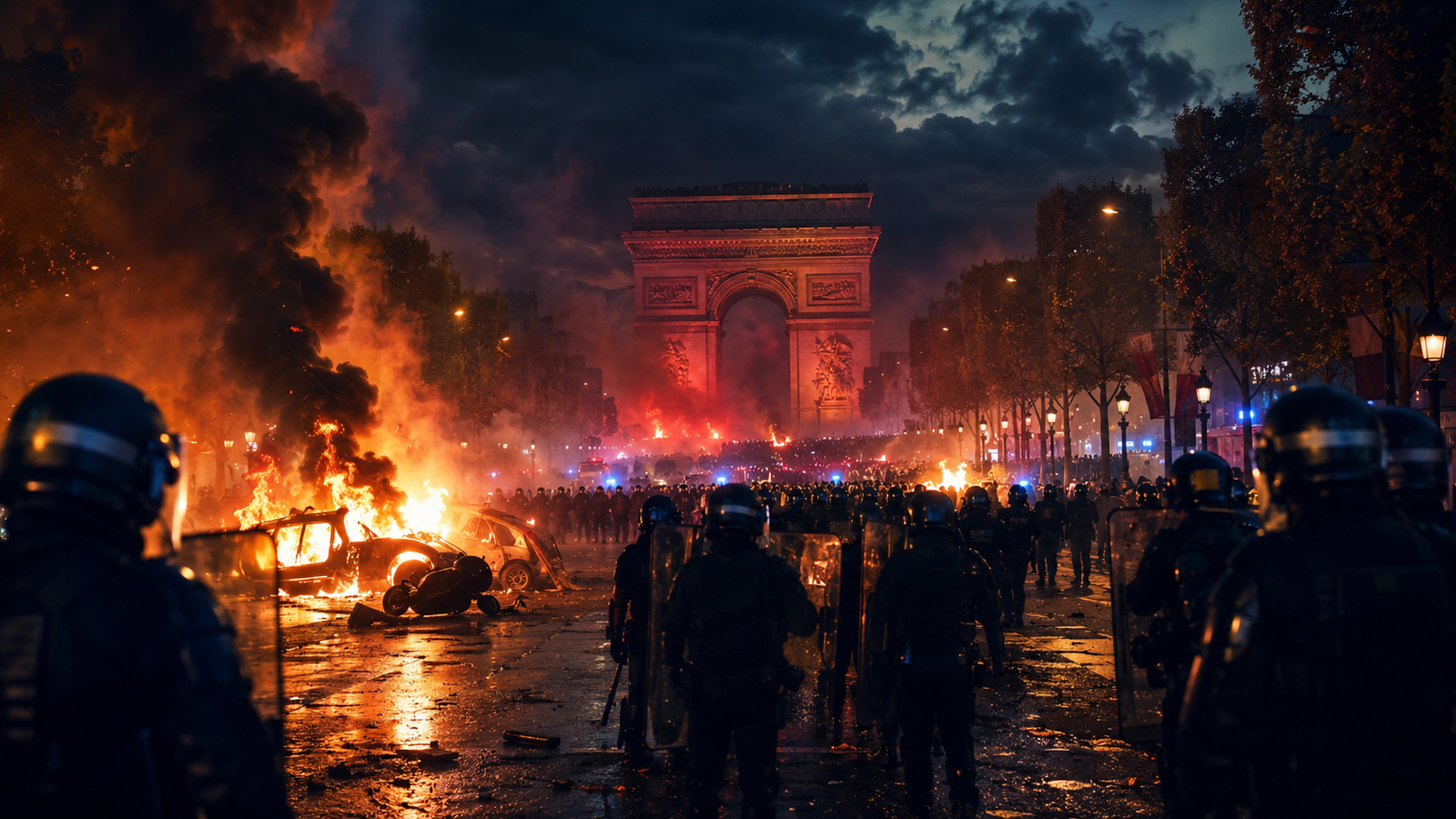
The images of burning cars, shattered glass, and smoke‑filled plumes rising from the Champs‑Élysées quickly spread across social media, triggering a wave of global reactions and harsh criticisms.
The situation proved particularly embarrassing for the European Commission. On May 7, just weeks before the riots, the Commission posted a meme on X (formerly Twitter) portraying a “ruined, dystopian” Paris as a figment of the imagination of conspiracy theorists. The post was intended to argue that such negative images of Europe were the result of manipulated narratives. Following the very real, very dystopian scenes from the weekend, users mercilessly trolled the Commission, pointing out that the “propaganda” image had effectively become a reality.
International observers and media quickly connected the violence to deeper governance failures in France. Some users on X compared the destruction in one of Europe’s most famous and visited capitals to scenes of a warzone. “This is Paris, France tonight. Import the third world, become the third world,” one viral comment read, encapsulating a popular online critique of European immigration and integration policies.
French conservative politicians also seized on the incident to criticize the government. Laurent Nuñez’s suggestion that the rioters were not PSG fans was met with skepticism by those who see the violence as symptomatic of a broader societal decay. The riots have now become a major talking point in France’s ongoing political debate about security, public order, and national identity, a debate that is unlikely to subside as the country continues to grapple with the aftermath.
What Comes Next? Government Measures and Long‑Term Implications
In the wake of the riots, the French government has announced a series of emergency measures. Prime Minister Élisabeth Borne chaired an emergency interministerial meeting on Sunday evening, where it was decided to accelerate the deployment of new surveillance drones in crowded areas and to fast‑track legislation that would impose automatic stadium bans for anyone convicted of sports‑related violence. The government is also considering the creation of a nationwide “fan ID” system, already used in some European countries, to screen individuals attending large gatherings.
For PSG, the club faces potential sanctions from UEFA and the French Football Federation. While the team cannot be held directly responsible for the actions of rioters, the repeated association of the club’s victories with national disorder has prompted calls to play future decisive matches behind closed doors—or even to deduct points. Club president Nasser Al‑Khelaïfi issued a statement condemning the violence “in the strongest possible terms” and pledged to cooperate fully with authorities to identify individuals who used the celebration as a pretext for criminal acts.
Locally, Paris Mayor Anne Hidalgo has requested an additional €5 million from the state to cover the cost of cleaning and repairing public property. “We are proud of our team, but ashamed of the vandals who dishonor the city,” she said. The city’s tourism industry, already struggling to recover from pandemic‑era lows and last year’s protests, now fears a new blow: travel advisories from foreign governments. The UK Foreign Office and the US State Department both issued updated warnings for Paris on Sunday, urging citizens to avoid large gatherings.
A City Left to Count the Cost : Paris riots 2026
As dawn broke over Paris on Sunday, the smell of tear gas still lingered on the Champs‑Élysées. Clean‑up crews worked through the morning to remove charred vehicles and shattered glass, while shop owners surveyed damage that, by preliminary estimates, will exceed €12 million. The contrast could not be starker: inside the Élysée Palace, players wore medals and smiled for photographs; outside, a few hundred metres away, riot police remained stationed at every major intersection.
For many ordinary Parisians, the night was one of fear, not celebration. “I locked myself in my apartment with my children at 10 pm,” said Marie Dupont, a 41‑year‑old teacher who lives near the Arc de Triomphe. “We heard explosions and screaming for hours. I don’t know when I’ll feel safe walking those streets again.”
The question that now dominates editorial pages and dinner‑table conversations across France is not whether the violence was justified—almost no one defends it—but whether the country has lost the ability to channel collective emotion peacefully. From the Yellow Vests to the pension protests to the suburban riots, the pattern is repetitive: a trigger, a conflagration, a government promise to “restore order,” and then a quiet return to the same brittle normalcy until the next eruption.
Conclusion: A Victory Tarnished
In the end, Saturday night’s riots were a tragic paradox. A moment of sporting glory—a feat that should have united France in pride—instead exposed its deep fractures. The nearly 900 arrests, the 219 injured, the one confirmed death, and the millions of euros in damage are not statistics; they are symptoms of a society struggling with inequality, alienation, and a breakdown of trust between citizens and the state.
President Macron’s call for “reason and responsibility” echoed hollowly over the sound of sirens. And as Paris rebuilds its shop fronts and its pride, the rest of the world watches and wonders: if a football victory can bring a European capital to the brink of chaos, what happens when the next real crisis arrives?
For now, a city known as the “City of Lights” has emerged from the weekend with some of its sparkle tarnished by smoke, tear gas, and a familiar sense of dread. The parties are over. The clean‑up has begun. But the underlying darkness that fuelled the flames remains, waiting for the next excuse to ignite.
HANTATAVIRUS: WHAT YOU NEED TO KNOW ABOUT THE RARE BUT DEADLY RODENT-BORNE VIRUS