
HANTATAVIRUS: WHAT YOU NEED TO KNOW ABOUT THE RARE BUT DEADLY RODENT-BORNE VIRUS
INTRODUCTION: A SILENT THREAT IN RURAL AMERICA
In the spring of 1993, a mysterious illness began striking young, healthy adults in the Four Corners region of the southwestern United States. What started as flu-like symptoms rapidly progressed to severe respiratory failure. Within weeks, over two dozen people were dead. The culprit? A previously unknown virus carried by deer mice — Hantavirus.
Three decades later, Hantavirus remains a rare but terrifying pathogen. It kills nearly 40% of those it infects, and there is no cure, no vaccine, and no specific treatment. Yet most Americans have never heard of it — or don’t know they are at risk.
This article explains everything you need to know about Hantavirus in 2024: how it spreads, who is most at risk, symptoms to watch for, and most importantly, how to prevent infection.
WHAT IS HANTAVIRUS?
Hantavirus is not a single virus but a genus of more than 20 different viruses carried by specific rodent species worldwide. Each strain is associated with a particular rodent host. The most dangerous strain in North America is the Sin Nombre virus (Spanish for “virus without a name”), carried primarily by the deer mouse (Peromyscus maniculatus).
Two Main Disease Forms
Hantavirus causes two distinct illnesses depending on the geographic region:
| Region | Disease Name | Primary Symptom | Fatality Rate |
|---|---|---|---|
| North & South America | Hantavirus Pulmonary Syndrome (HPS) | Severe respiratory distress | 36–40% |
| Europe & Asia | Hemorrhagic Fever with Renal Syndrome (HFRS) | Kidney failure | 1–15% |
This article focuses on HPS, the form found in the United States and Canada.
HOW DO YOU CATCH HANTAVIRUS?
The most common misconception: You do not get Hantavirus from being bitten by a rodent. Instead, infection occurs through inhalation of aerosolized rodent droppings, urine, or saliva.
Primary Transmission Routes
| Transmission Method | Likelihood | Explanation |
|---|---|---|
| Inhalation of dust | Very High | Disturbing dried droppings, nests, or contaminated insulation releases virus particles into the air. |
| Direct contact | Moderate | Touching droppings then touching mouth, nose, or eyes. |
| Rodent bite | Low | Rare, but possible if the rodent is infected. |
| Person-to-person | Extremely Rare | Only documented with Andes virus (South America). Not seen with North American strains. |
High-Risk Activities
You are most at risk when you disturb rodent habitats in enclosed spaces. Common scenarios include:
Spring cleaning cabins, sheds, barns, or garages left untouched over winter
Cleaning out basements, attics, or crawl spaces with visible rodent droppings
Camping or hiking in rodent-infested areas (less common, but possible)
Agricultural work in fields or grain storage facilities
Entering vacant buildings after prolonged rodent activity
Real-world example: In 2012, a group of campers at Yosemite National Park were exposed to Hantavirus while staying in “Signature Tent Cabins” that had mouse infestations. Ten people were infected, three died.
GEOGRAPHY: WHERE IS HANTAVIRUS FOUND?
Hantavirus follows its rodent host. In North America, the deer mouse ranges across nearly the entire continent, but human cases are concentrated in rural areas west of the Mississippi River.
Highest-Risk U.S. States (1993–2022)
Based on CDC data, the following states report the most HPS cases:
New Mexico (most cases per capita)
Colorado
Arizona
California
Texas
Washington
Montana
South Dakota
Note: Cases have been reported as far east as Michigan, New York, and Florida, but they remain extremely rare east of the Mississippi.
Seasonal Pattern
Most cases occur in spring and early summer (April–July). This coincides with people cleaning out winter-sealed buildings, as well as increased rodent activity and population density.
SYMPTOMS: THE DIFFERENCE BETWEEN COLD AND KILLER
The early symptoms of Hantavirus look exactly like the flu. This delays diagnosis and contributes to the high fatality rate. Time is critical.
Phase 1: Early Symptoms (Days 1–4)
Fever (101°F or higher)
Severe muscle aches (especially in thighs, hips, back, and shoulders)
Fatigue and weakness
Chills and dizziness
Headache
Nausea, vomiting, or diarrhea (in about half of patients)
There is no cough or runny nose in the early phase — unlike COVID or the flu.
Phase 2: Cardiorespiratory Phase (Days 4–10)
This is when Hantavirus becomes lethal. Fluid leaks from small blood vessels into the lungs, causing:
Shortness of breath (first with exertion, then even at rest)
Cough (dry, non-productive)
Rapid heartbeat and low blood pressure
Lungs filling with fluid (pulmonary edema)
Oxygen saturation dropping below 90%
Once respiratory symptoms appear, patients typically require hospitalization within 24 hours. Without intensive care, death can occur within 48 hours.
Key warning sign: If you develop fever and muscle aches followed by sudden shortness of breath within 2–6 days — especially if you’ve been around rodent droppings — go to an emergency room immediately and tell the doctor about possible Hantavirus exposure.
DIAGNOSIS: WHY IT’S OFTEN MISSED
Hantavirus is notoriously difficult to diagnose in the early stage because:
Symptoms mimic influenza, COVID-19, and other viral illnesses.
Doctors in non-endemic areas may never have seen a case.
No rapid test exists for early-stage HPS.
Diagnostic Process
If Hantavirus is suspected, doctors will:
Take a detailed exposure history (rodent droppings, cleaning cabins, rural travel)
Order blood tests for Hantavirus antibodies (IgM and IgG)
Perform chest X-ray or CT scan to look for pulmonary edema
Rule out other causes (COVID, flu, bacterial pneumonia)
Critical note: Standard flu or COVID tests will not detect Hantavirus. You must specifically request Hantavirus testing if you have a known exposure history.
TREATMENT: NO CURE, BUT EARLY CARE SAVES LIVES
There is no antiviral medication specifically for Hantavirus. Treatment is entirely supportive — meaning doctors manage symptoms and complications while your immune system fights the virus.
Hospital Care for HPS
| Intervention | Purpose |
|---|---|
| Oxygen therapy | Maintain blood oxygen levels |
| Mechanical ventilation | Breathing tube and machine for severe cases |
| Intravenous fluids | Maintain blood pressure |
| Hemodynamic monitoring | Track heart and lung function |
| ECMO (Extracorporeal Membrane Oxygenation) | Advanced life support for end-stage respiratory failure |
Why Early Hospitalization Matters
Patients who receive intensive care before severe respiratory failure have survival rates above 90%. Those who arrive in the emergency room already struggling to breathe face a 50/50 chance.
Case fatality rate: Among confirmed HPS cases in the U.S. (1993–2022), 36% died. However, during the 1993 outbreak, the fatality rate exceeded 70% before doctors learned to treat the respiratory phase aggressively.
Experimental Treatments
Ribavirin (antiviral drug) has shown mixed results. It is not FDA-approved for HPS but may be used in some cases.
Convalescent plasma (antibodies from recovered patients) has been tried with limited success.
Extracorporeal membrane oxygenation (ECMO) has saved some severe cases when available.
PREVENTION: THE ONLY REAL DEFENSE
Because there is no vaccine or cure, prevention is everything. The CDC estimates that nearly all Hantavirus infections are preventable with proper cleaning and rodent control.
10-Step Rodent-Proofing Checklist for Homes, Cabins, and Sheds
Seal entry points — Use steel wool, caulk, or sheet metal to close holes larger than a dime.
Set snap traps — Avoid glue traps or poison, which can leave droppings and carcasses.
Remove rodent harborage — Clear woodpiles, brush, and junk away from building foundations.
Store food properly — Use metal or glass containers with tight lids.
Dispose of trash regularly — Use rodent-proof bins.
Elevate hay, wood, and grain — At least 12 inches off the ground.
Trim vegetation — Keep grass and shrubs short near buildings.
Use chimney caps and vent screens — Prevent rodents from entering through ducts.
Do not leave pet food out overnight — It attracts rodents.
Set up early warning systems — Bucket traps with cameras (for rural properties)
Safe Cleaning Protocol (Do Not Sweep or Vacuum)
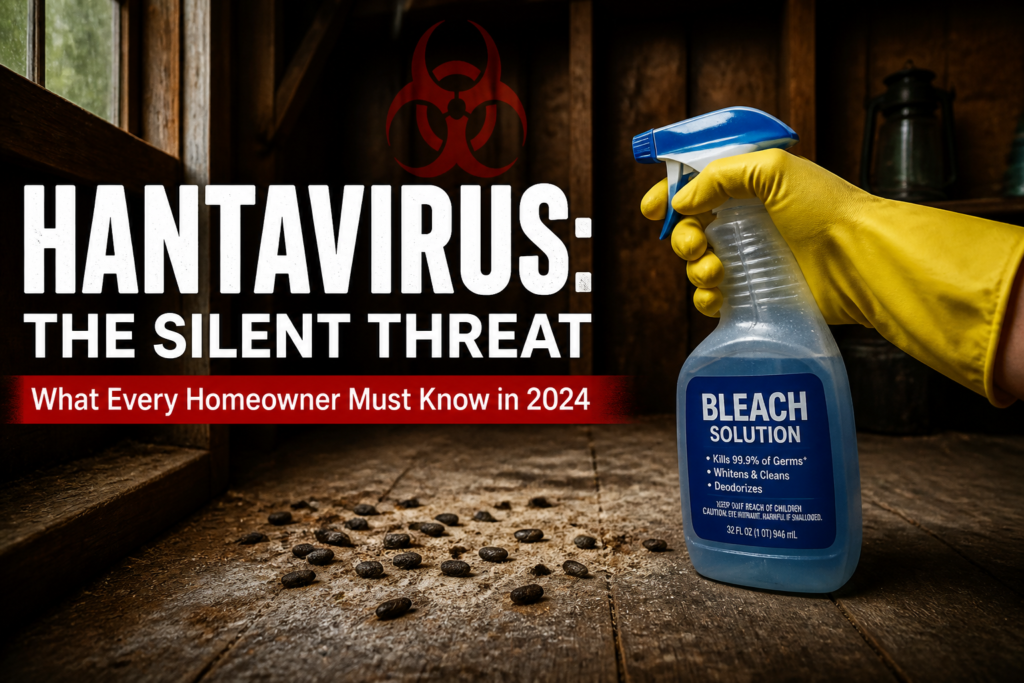
This is the most critical prevention advice: Never dry-sweep or vacuum rodent droppings. This aerosolizes the virus.
Correct cleaning method (CDC-approved):
Ventilate the area for 30 minutes before entering.
Wear rubber gloves, N95 mask, and goggles.
Mix bleach solution: 1½ cups household bleach per 1 gallon of water.
Soak droppings and nests thoroughly with the solution.
Wait 5 minutes for the virus to be inactivated.
Mop up with paper towels (do not sweep).
Double-bag all waste in plastic bags.
Disinfect gloves before removing them.
Wash hands thoroughly with soap and water.
Do NOT use a vacuum or broom. Even HEPA vacuums can re-aerosolize the virus.
MYTHS VS. FACTS ABOUT HANTAVIRUS
| Myth | Fact |
|---|---|
| “Hantavirus is airborne like COVID.” | No. It becomes airborne only when dried droppings are disturbed. It does not spread through casual contact. |
| “Pets can give you Hantavirus.” | No. Pets cannot carry or transmit Hantavirus to humans, but they can bring infected rodents into your home. |
| “You can see the virus in droppings.” | No. Infected rodent droppings look identical to uninfected ones. Assume all droppings are infectious. |
| “Once you survive, you’re immune for life.” | Possibly, but reinfection has been reported. Immunity may not be lifelong. |
| “Hantavirus only affects the elderly.” | No. Most victims have been young, healthy adults (average age 37). |
NOTABLE OUTBREAKS AND CASE STUDIES
1993: Four Corners Outbreak (U.S.)
The outbreak that discovered Sin Nombre virus. 24 cases, 12 deaths (50% fatality rate at the time). Caused by increased deer mouse populations following heavy rainfall.
2012: Yosemite National Park (California)
10 confirmed cases, 3 deaths. Linked to “Signature Tent Cabins” with unsealed walls that allowed mouse entry. The park later removed the cabins.
2018–2020: Argentina & Chile (Andes Virus)
Rare documented case of person-to-person transmission of an Andes virus strain. Led to quarantine measures not seen with North American Hantavirus.
2021: Washington State (USA)
A 35-year-old man died after cleaning a garage with rodent droppings. He was healthy with no underlying conditions.
WHAT TO DO IF YOU THINK YOU’VE BEEN EXPOSED
If you have fever, muscle aches, and difficulty breathing within 8 weeks of rodent exposure:
Call your doctor or go to the ER immediately. Do not wait for symptoms to worsen.
Say these exact words: “I may have been exposed to Hantavirus. Please test me and consider early supportive care.”
Provide exposure history: When and where you saw rodent droppings or nests.
Do not drive yourself if you have shortness of breath. Call an ambulance.
If you are not yet symptomatic but had a high-risk exposure (e.g., cleaning a heavily infested cabin without a mask), monitor yourself for 8 weeks. Seek medical evaluation immediately at the first sign of fever or muscle aches.
THE FUTURE: VACCINES AND BETTER TREATMENTS
As of 2024, there is no FDA-approved Hantavirus vaccine. However:
Several experimental vaccines have been tested in animals and early human trials (China has a vaccine for HFRS, but it is not available in the U.S.).
mRNA technology (similar to COVID vaccines) is being explored for Hantavirus.
Improved ECMO access has reduced fatality rates in major medical centers to under 20% for patients who reach the hospital early.
The CDC continues to track Hantavirus as a Category A bioterrorism agent (alongside anthrax and Ebola) due to its high fatality rate and aerosol transmission potential.
CONCLUSION: RESPECT THE RODENT, BUT DON’T PANIC
Hantavirus is terrifying — but it is also extremely rare. Since 1993, fewer than 1,000 cases have been confirmed in the United States. By comparison, over 40,000 Americans die from seasonal flu each year.
Yet rarity does not mean irrelevance. For people living in rural areas, cleaning out cabins, or working in agriculture, Hantavirus is a real — and preventable — threat.
The takeaway is simple:
Never dry-sweep rodent droppings.
Ventilate, wet down, mask up, and double-bag.
If you get fever + muscle aches + breathlessness after exposure, go to the ER and demand a Hantavirus test.
With proper precautions, you can coexist safely with the deer mouse. Without them, you roll the dice on one of America’s deadliest viral infections.
Have you ever cleaned out a shed, cabin, or basement with rodent droppings? Share your experience and safe cleaning tips in the comments below.






Pingback: Paris riots 2026: 900 Arrests as PSG Victory Turns to Chaos